
First, a little backstory.
When Octavus Media first started, we didn’t know where we would end up. We were a small team working with small businesses, musicians, and entrepreneurs and anyone else who was interested in collaborating on creative work. As a result, the work was varied, and we learned fast.
Then, in 2021, we had the opportunity to create a series of videos for a major capital campaign in Woodburn, Oregon. The campaign supported Anahuac, a community-centered farm and educational program of the Capaces Leadership Institute that shares Indigenous traditions through agriculture, culinary and cultural arts, wellness, and language. The goal was to raise funding to acquire farmland that would allow the organization to grow and expand its educational programs.
The interviews were engaging, the client was passionate, and the footage was gorgeous…and the campaign? It raised nearly $5 million toward bringing that vision to life.
Typically, at the end of every creative project (after the late nights, early mornings, tears, and a steady diet of masubi and redbull) there is a sense of fulfillment and accomplishment. The project is done. You’re satisfied with the work, and the client is happy. Sure. Maybe something for the portfolio.
But when we learned that the campaign had nearly reached its funding goal—and that the videos played a significant role in its success—we were ecstatic. We decided to lean into working with nonprofits and never looked back.
Now back to the name.
We had chosen the name Octavus (latin root for octave) as a nod to Simon’s roots in the music industry (his pre-COVID life). And it worked…sort of.
Until we repeatedly heard it mispronounced. Mispelled. Pronounced with additional letters.
“Octavius?” “Oct-AY-vus?” “Oct-O-vus?”
We even heard “Octopus” on one occasion.
And we shrugged it off. Can’t blame people…it’s a random, latin word! Folks will learn it eventually! But over the last 5 years, the naming issues persisted. Clients we adored were still mispronouncing our name when referring our services. Our family members even consistently said the wrong name.
But most importantly, the name didn’t really fit who we were anymore.
Story Squire.
So we went back to the drawing board.
We wanted something easy to say, easy to spell, and easy to remember after hearing it once. But most of all, we wanted it to feel at home with the work we were doing in the nonprofit sector.
As creative storytellers, we’ve been indoctrinated in something called Story Branding which relies heavily on a concept known as the Hero’s Journey. In 1949, Campbell published The Hero with a Thousand Faces. In it, he argued that nearly every great story, from ancient myths to Star Wars, follows the same basic shape. He called it the Hero’s Journey.
The Hero’s Journey | 12-step adaptation
The Ordinary World. We meet the hero in everyday life, before the adventure begins.
The Call to Adventure. A problem, challenge, or opportunity disrupts the status quo.
Refusal of the Call. The hero hesitates out of fear, doubt, or obligation.
Meeting the Mentor. A guide offers advice, training, or a gift that gives the hero courage.
Crossing the Threshold. The hero commits and leaves the familiar world behind.
Tests, Allies, and Enemies. The hero learns the rules of the new world, makes friends, and faces opponents.
Approach to the Inmost Cave. The hero prepares for the biggest challenge ahead.
The Ordeal. The hero faces their greatest test and often comes close to failure or “death.”
The Reward. Having survived, the hero gains something: knowledge, a treasure, or a breakthrough.
The Road Back. The hero heads home, often chased by lingering consequences.
The Resurrection. One final test, where the hero is transformed by everything they’ve learned.
Return with the Elixir. The hero comes home changed, bringing something that benefits their community.
In Hollywood, the Hero’s Journey is the backbone for several blockbuster movies (think Star Wars, Lord of the Rings, Wizard of Oz, Miss Congeniality). And somewhere along the way, the business and marketing worlds got ahold of it, too. These days, it’s practically a cliché. It’s been recycled through decades of marketing classes, TED Talks, leadership books, and sales frameworks. And if you’ve ever sat through a marketing webinar, chances are you’ve heard it at least twice.
But here’s the thing: as cheesy as it is, we work with actual heroes in the nonprofit sector every day.
Folks in the nonprofit world tend to be humble to a fault (try complimenting one and watch them immediately credit their whole team). But the work they’re doing goes way above and beyond what any of us are expected to do. Devoting your professional life to a meaningful cause translates to late nights, less sleep, tight budgets, and a very real risk of burnout. It’s not easy work, and it’s rarely glamorous.
But they persist. Because it’s work they believe in. They’re on a quest to make a difference and damn the danger they face along the way.
We don’t see our clients as just “clients.” We see them as the heroes of their communities doing their part to promote positive change in the world. And how we envision ourselves isn’t Yoda or Gandalf. We don’t want to be the sage in the cave giving advice and sending the hero on their way…
Our job is to roll up our sleeves and provide our heroes with the tools they need to be champions of their mission; sharing their story in a way that moves people, so the right folks hear it and want to join the quest.
Less like a wizard. More like a squire.
Crafting a brand
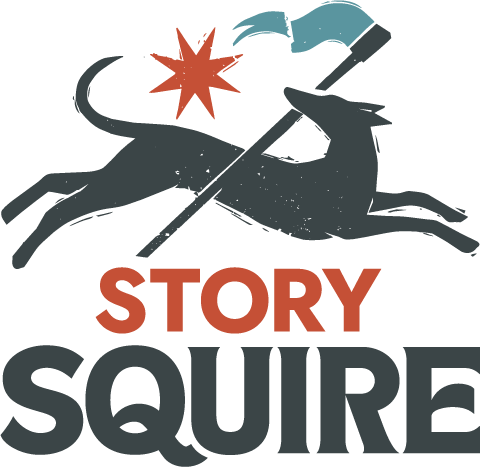
The new visual identity needed to feel different. Human. And a little imperfect. So we turned to a craft that I once utilized in my early design years; printmaking.
I wanted the new brand to feel hand-crafted—an intentional turn away from ai and the slick corporate look that Apple and other moguls have powerwashed the branding landscape with over the last two decades.
The logo was first sketched, then carved into print-makers linoleum, then cleaned up digitally and made into a scaleable vector graphic that became the base for Story Squire.
So what’s changing?
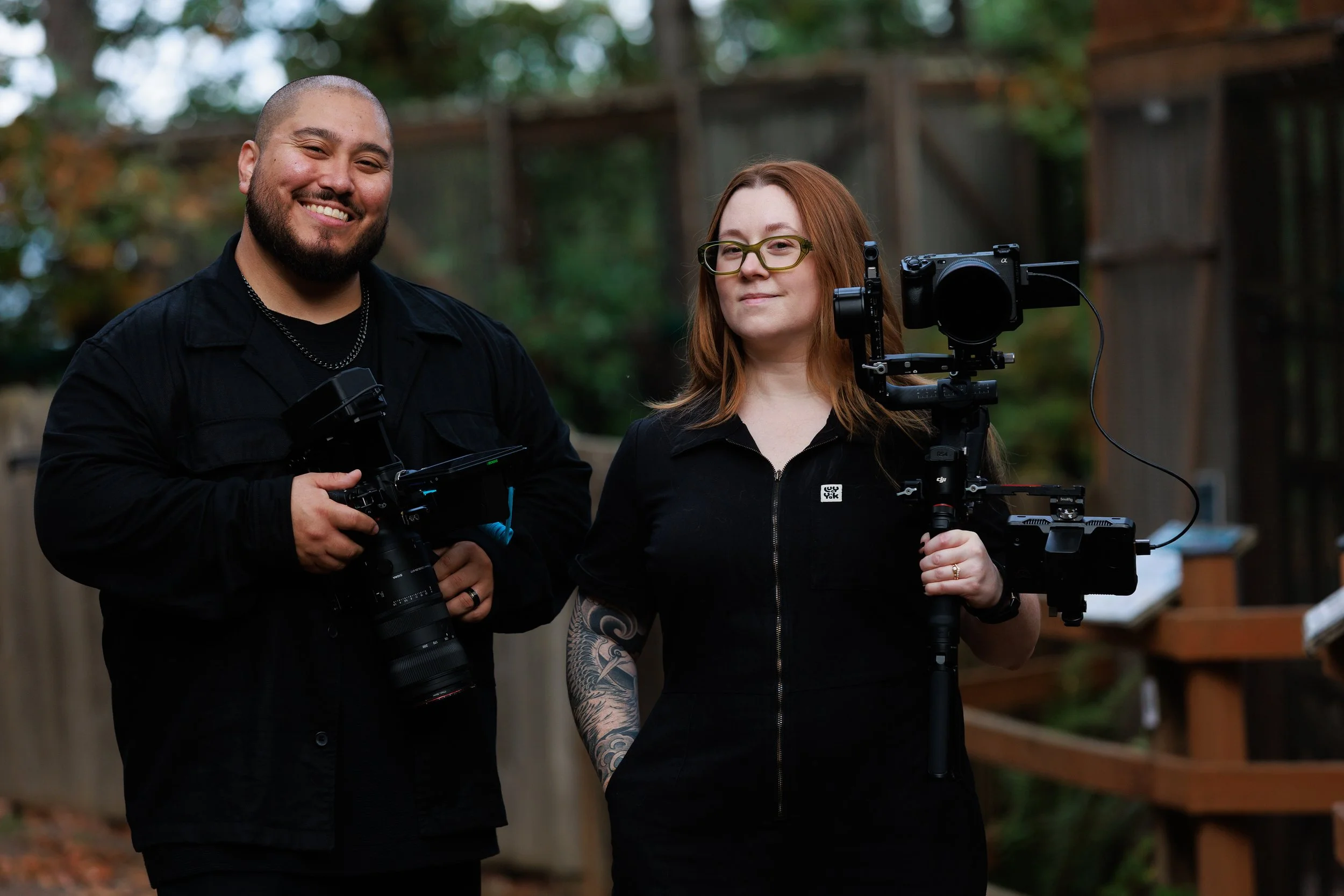
Honestly? Not much, other than the name on the website, the email addresses, and the business cards. Same people, same late nights, same questionable meal choices. Simon is still leading the ship as media director, and I’m still here as creative director, obsessing over fonts and branding.
What is growing is what we offer. Video is still our bread and butter, but we’re also building websites, designing graphics, and creating brands for nonprofits who need their whole story to hang together, not just the video part. (More on that later.)
And to everyone who learned how to say “Octavus”…
Thank you. We see you. We appreciate you. You can retire that knowledge now.
Here’s to the next chapter.
—Cat B.
